

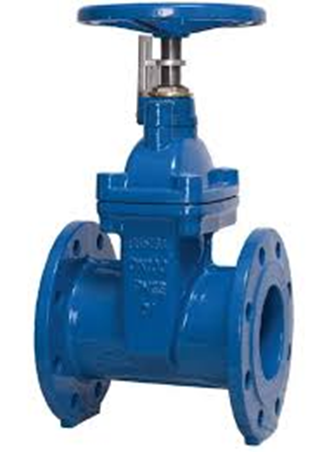
Application:
Sluice valves (or gate valves) are primarily used for on/off, isolation, and flow regulation of high-volume fluids in, waterworks, municipal water distribution, sewage treatment, power plants, and industrial piping. They are ideal for high-pressure, high-temperature applications where they are either fully opened or closed to ensure minimum, unrestricted flow and to prevent erosion.
Class: PN 10, PN 16, PN 20, PN 25
Design Standard: IS 14846
Size: 50 mm to 1800 mm
Body & Bonnet: Cast Iron (IS 210 Gr FG 200/260), Ductile Iron (SG Iron), Cast Steel (ASTM A216 WCB).
Wedge/Gate: Cast Iron, Ductile Iron, or Stainless Steel.
Seat Ring/Wedge Face Ring: Leaded Tin Bronze (LTB) or Stainless Steel (AISI 410/304/316).
Stem/Spindle: Stainless Steel (AISI 410/304/316) or High Tensile Brass.
Gland Packing/Gasket: Rubber, PTFE, or Graphite/Asbestos.
Coating: Fusion Bonded Epoxy (FBE) (min 250-300 microns) for corrosion protection.
Ends: Flanged End
Operation: Hand wheel, Gear, Electric actuator
